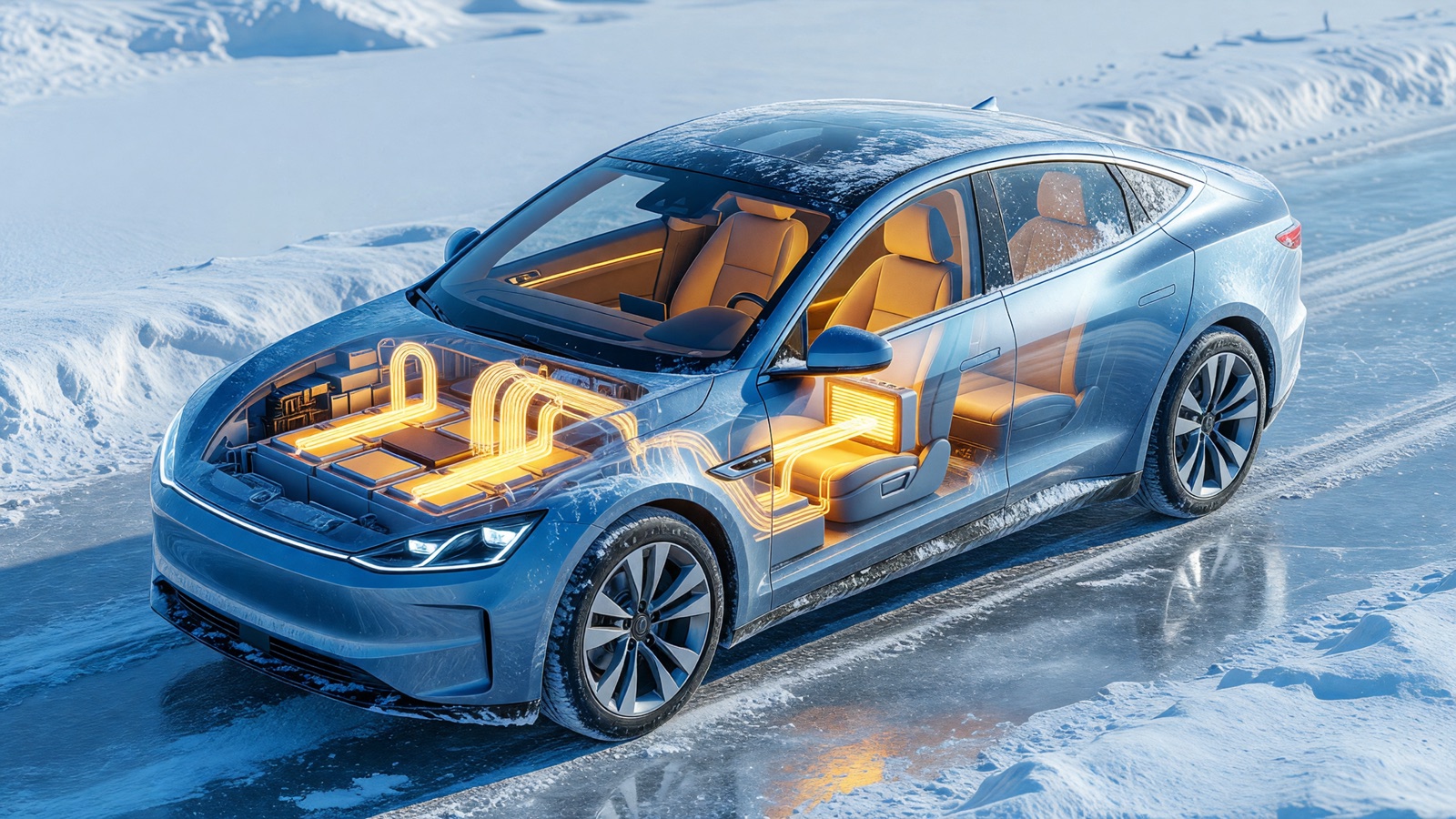
Winter EV range drops mostly because cabin heating draws power from the battery. A dashboard showing 280 miles in October might show around 220 on a 32°F morning, or closer to 170 at 20°F with the heat blasting. Fleet data puts the typical freeze-day loss near 20 percent; lab tests with the heater on put it near 39 percent. That drop does not by itself mean the pack is ruined.
After a night in the driveway, the range estimate can change before you turn on the heater. At 6:40 a.m., last night’s 268 miles might read 191. Cold slows the battery’s chemistry, and heating the cabin draws more power from it. A gasoline car uses waste engine heat for that job.
Why does my EV lose so much range when I turn the cabin heat on?
Cabin heat accounts for much of the loss. A gasoline engine sends leftover heat through the vents; an electric car draws energy from the traction battery to warm the cabin. The U.S. Department of Energy says about two-thirds of the extra winter energy goes to cabin heating rather than driving.
Recurrent, which reads telematics from tens of thousands of U.S. EVs, says: “The major reason that EVs lose range in the winter is due to cabin heating to keep the driver and passengers warm.” Lithium ions also move more slowly in a cold cell, so the pack cannot deliver as much power as it did in May. That effect accounts for a smaller part of the loss.
The Department of Energy’s cold-weather page splits the two effects. “When the cabin heater is not used, EV fuel economy is 8% lower at 20°F than at 75°F.” Range in that heater-off case is about 12 percent lower. Turn HVAC on, and DOE’s summary jumps to roughly 39 percent less fuel economy and 41 percent less range in mixed driving.
On a 12-mile school run with three stops, each open door lets warm air out. The car then uses energy to bring the cabin back to 72°F, even at a red light. Consumer Reports found short trips with repeated reheating can cut range in half. Its 70 mph cruise at about 16°F showed a smaller cut, closer to 25 percent versus a mid-60s day.
A resistive cabin heater makes heat directly from electricity. Some independent writeups put its draw at 3 to 5 kW, but that wattage has not been verified here for a named 2026 model. Treat it as a general figure rather than a model specification. In city traffic, cabin heating can draw more power than the motor.
How much range do EVs lose at 32F versus 20F?
Plan for about one-fifth less range at freezing, or closer to two-fifths at 20°F with the heater running. The figures come from different conditions. Recurrent’s 30,000-car U.S. fleet shows about 22 percent loss at 32°F; AAA’s 2026 climate-cell dynamometer test shows about 39 percent at 20°F with HVAC on.
Recurrent’s 2025/2026 winter study used real trips. At 32°F, the average model kept about 78 percent of its range in ideal weather, usually 70°F to 80°F. At 20°F, average retention was near 70 percent. Those results include the climate settings drivers used on their actual trips.
AAA straps a car to a dynamometer in a climate cell. NPR reported the 2026 results first: 39 percent less range at 20°F, 8.5 percent less at 95°F. The 2019 version, with different cars, found a 41 percent hit at 20°F with HVAC on. Greg Brannon, AAA’s director of automotive engineering, told NPR, “the electric vehicles actually didn’t change all that much from back in 2019.”
The 2019 AAA release still has the January sentence: “when the mercury dips to 20°F and the HVAC system is used to heat the inside of the vehicle, the average driving range is decreased by 41 percent.” For a car that would do 100 mixed miles at 75°F, that is 59 miles.
| Test | Temperature | Cabin climate | Range versus mild weather |
|---|---|---|---|
| Recurrent fleet, 30,000+ U.S. cars, 2025/26 | 32°F | mixed real use | about 78% kept (22% loss) |
| Recurrent fleet, same study | 20°F | mixed real use | about 70% kept |
| AAA climate-cell dyno, 2026 | 20°F | HVAC on | 39% loss |
| AAA climate-cell dyno, 2019 | 20°F | HVAC on | 41% loss |
| DOE summary of EV tests | 20°F | heater off | about 12% range loss |
| AAA climate-cell dyno, 2026 | 95°F | A/C on | 8.5% loss |
| Consumer Reports highway loop | about 16°F | 70 mph cruise | about 25% loss |
| Consumer Reports, earlier short-trip work | cold, stop-and-go | cabin reheated after stops | up to 50% loss |
A manufacturer calculator can show a larger loss than a fleet average because it fixes speed and climate settings. Parkers published Citroen’s official e-C4 figures: 217 miles at 20°C, 194 at 10°C, 175 at 0°C, and 141 at -10°C. The last figure is 35 percent below the 20°C estimate. Parkers’ long-term Renault 5 E-Tech was closer to 150 miles in the cold against about 200 in summer.
Canada’s CAA drove 13 models from Ottawa toward Mont-Tremblant. The Chevrolet Silverado EV and Polestar 2 were down 14 percent. A Hyundai in that group covered 307 kilometres against a 410 kilometre sticker. The Toyota bZ4X and Volvo XC40 Recharge sat at the bottom of that day, down 37 percent and 39 percent. One cold highway is not a season, but the spread between models is wide.
A DOE technical paper shows around 50 percent average range loss for 0°F city driving with HVAC, including a 59 percent urban case in that figure. Those are more severe conditions than most January commutes.
Does a heat pump stop winter range drop in an EV?
No. A heat pump reduces winter range loss but does not eliminate it. Recurrent found heat-pump cars keep about 10 percent more range at 32°F than cars with resistive heaters. That advantage fades toward 0°F, when a heat pump is about as efficient as a resistive unit.
A heat pump moves heat instead of making it with a glowing element. Recurrent’s version: for every unit of electricity consumed, a heat pump can generate 3 to 4 units of heat. That is why a 2021-and-later Tesla with heat-pump hardware tends to look better in winter tables than an older resistive car with the same badge. Recurrent has also flagged the U.S.-spec Volkswagen ID.4 as a resistive-heat example that sits near the bottom of those tables.
Check heat-pump fitment for the exact year and market before buying; it has not been verified here for every 2026 trim. Some brands add a resistive booster that runs even in moderately cold weather, warming the cabin while drawing more energy. Look for “heat pump” on the specification page rather than relying on a brochure’s description of thermal management.
Will a winter range drop permanently damage my EV battery?
No. The miles you lose in January come back when the weather warms up. Recurrent’s winter study is blunt: winter range loss is temporary, with no long-term detriment to the battery. What does age a pack is a separate story: years of heat, high charge, and fast charging, not one cold Tuesday.
The exact line on Recurrent’s page is: “No, any range loss from winter weather is temporary and there is no long term detriment to your battery.” The guessometer that scared you at 6:40 a.m. should climb as the pack warms, and the full-charge estimate should look normal again in April.
Cold cells accept current more slowly, so many cars limit DC fast charging until the pack warms. Recurrent advises allowing more time and using battery preconditioning on the way to a charger if the car’s navigation supports it. A mileage wear penalty for cold DC charging on a specific model has not been verified here.
After an unplugged night at 18°F, the car may use some energy for thermal management and display less range because the pack is cold. Plug in if you can. Otherwise, the next drive starts with a colder battery; the lower estimate alone does not mean it is damaged.
What can I do before a winter commute so the battery lasts?
Warm the cabin and the pack while the car is still plugged in. That one habit moves the heating bill onto the wall outlet instead of the battery you need for the drive. AAA and Recurrent both put preconditioning at the top of the list. Heated seats and a garage stall help after that.
Set a departure time in the app, or start climate from the phone ten minutes before you walk out, while the cord is still in. NPR quoted Brannon on the same point: it can be overcome, but you have to plan for it. Consumer Reports timed scheduled departure on a few models and saw about 5 to 7 percent better efficiency and a few extra points of charge after a cold 100-mile loop.
Once you are moving, heated seats and a heated wheel warm you with a few dozen watts instead of a few thousand. Turn the cabin target down a few degrees. I have not copied CR’s seat-heater watt table because I did not pull it.
Keep tire pressure at the door-sticker number. Cold air drops pressure, and low tires waste energy. Snow tires add rolling resistance versus summer rubber; that is safety, not a defect. Dense cold air also raises drag on the highway. None of that is unique to EVs. DOE already puts a gasoline car about 15 percent worse in city driving at 20°F versus 77°F.
Park in a garage when one is available. Starting at 40°F in a garage rather than 18°F on the street gives the car a milder start, as AAA noted in 2019.
On a road trip, leave a bigger buffer than the summer you remember. A cold pack will drink a public stall more slowly. Use the car’s nav to the charger so the pack can warm on approach. If the first minutes at a 150 kW cabinet crawl at 28 kW, that is the battery protecting itself. I have not verified a typical kW curve for any 2026 model in 15°F air, so treat that 28 kW as a scene, not a measurement.
What do people still ask about EV range in winter?
A parked EV may show fewer miles in the morning because the pack is cold or the car used energy to keep it warm. DC fast charging can slow until the cells heat up. Gasoline cars also lose fuel economy in cold weather.
Does a lower number on the dash in the morning mean the battery is dying?
Usually no. A cold pack reports less available energy, and some cars warm their cells overnight. Recurrent says winter range loss is temporary. If the full-charge estimate in April remains far below last April’s, aging or a fault may be involved. A low reading on one 19°F Tuesday is not enough to tell.
Should I leave the car plugged in all night in January?
Yes if you can. The wall can feed preconditioning and battery warming so the drive starts from a warm pack. Recurrent suggests a 70 or 80 percent charge cap for storage on many cars, with the cord in, so thermal management pulls from the grid. I have not verified that cap for every chemistry, including LFP, so follow the manual for your pack.
Why is the DC fast charger so slow when it is freezing?
The car is protecting the cells. Lithium plating risk goes up when you shove high current into a cold anode, so the software caps the rate until the pack is warm. Preconditioning on the way there is the fix that actually works. Standing at 12 percent in a windy stall, watching a 350 kW cabinet do 40 kW, is the version nobody forgets.
Do gasoline cars lose range in winter too?
They do. DOE puts a conventional gasoline car about 15 percent worse in city driving at 20°F versus 77°F, and up to 24 percent worse on a 3- to 4-mile trip. Hybrids can drop more because the engine spends less time making waste heat. AAA’s 2026 dyno work found about 23 percent less efficiency for the hybrids in that test at 20°F. You just refill in five minutes.